Human rights law is a vital area of international law, focusing on protecting the fundamental rights and freedoms to which all humans are entitled, regardless of nationality, sex, national or ethnic origin, race, religion, language, or any other status. This field is critical in today’s global society as it provides the legal framework for the protection of the dignity and worth of every individual. It empowers people to challenge injustices and hold governments and private actors accountable for violations and abuses.
Education in human rights law plays a crucial role in fostering a deep understanding of and commitment to these universal principles. Through specialized courses and training, students learn not only the legal aspects of human rights but also the ethical and philosophical foundations that underpin them. This education is essential for developing the next generation of advocates who are passionate about defending and promoting human rights around the world.
This article aims to explore the various educational paths and opportunities in human rights law that help cultivate skilled advocates. We will examine how different programs and experiences can equip individuals with the knowledge and skills needed to effectively fight for human rights and make a significant impact in the field.
Historical Context and Evolution of Human Rights Law
From the Universal Declaration to Today
The foundation of modern human rights law was laid with the adoption of the Universal Declaration of Human Rights in 1948, a seminal document that set out the basic civil, political, economic, social, and cultural rights that all human beings should enjoy. This moment marked a crucial turning point in international law and has since inspired a series of international treaties and national laws aimed at protecting these fundamental rights.
Influence of Historical Milestones
The evolution of human rights law has been significantly shaped by historical milestones. For example, the establishment of the International Criminal Court and the development of various regional human rights frameworks like the European Convention on Human Rights and the African Charter on Human and Peoples’ Rights have both expanded the reach and enforcement of human rights globally. These developments have transformed the landscape of human rights advocacy, providing more avenues through which victims can seek redress.
Teaching and Practicing with Historical Insight
Understanding the historical context is paramount in teaching and practicing human rights law today. It helps advocates appreciate the progress made and recognize the ongoing challenges in the fight against human rights violations. Educators use these historical perspectives to illustrate the dynamic nature of human rights law and to instill a robust sense of duty and purpose in their students. This historical insight not only enriches the students’ learning experience but also deepens their commitment to advancing human rights globally.
Educational Pathways in Human Rights Law
Academic Routes for Aspiring Human Rights Lawyers
The journey to becoming a human rights lawyer typically begins with a solid foundation in legal education, which can be pursued through various academic routes. Undergraduate degrees in fields such as political science, international relations, or sociology provide a strong preparatory background. However, the critical pathway involves obtaining a law degree, where students can focus more directly on human rights issues. Postgraduate studies, including Master’s degrees or PhDs in human rights law, offer further specialization and are particularly valuable for those aiming to engage in policy work or academic teaching and research.
Core Areas of Focus in Education
Human rights law education encompasses a broad range of topics, designed to give students a comprehensive understanding of the field. Key areas of focus include international human rights, which deals with global human rights treaties and conventions; civil rights, focusing on individual rights and freedoms; and humanitarian law, which addresses the rules of war and rights during conflicts. These courses are supplemented by specialized studies in areas like refugee law, children’s rights, and gender rights, providing students with a well-rounded perspective on the varied aspects of human rights law.
Credentials and Certifications
Beyond traditional degrees, aspiring human rights lawyers can benefit from various credentials and certifications that enhance their qualifications. Certificates in human rights law, often offered by law schools or international human rights bodies, can provide additional specialized training. Bar certification in jurisdictions where they intend to practice is crucial for legal professionals, and additional credentials, such as diplomas in international human rights law from accredited institutions, can be instrumental in establishing expertise and credibility in the field.
Building Foundations: Academic Pathways in Human Rights Law
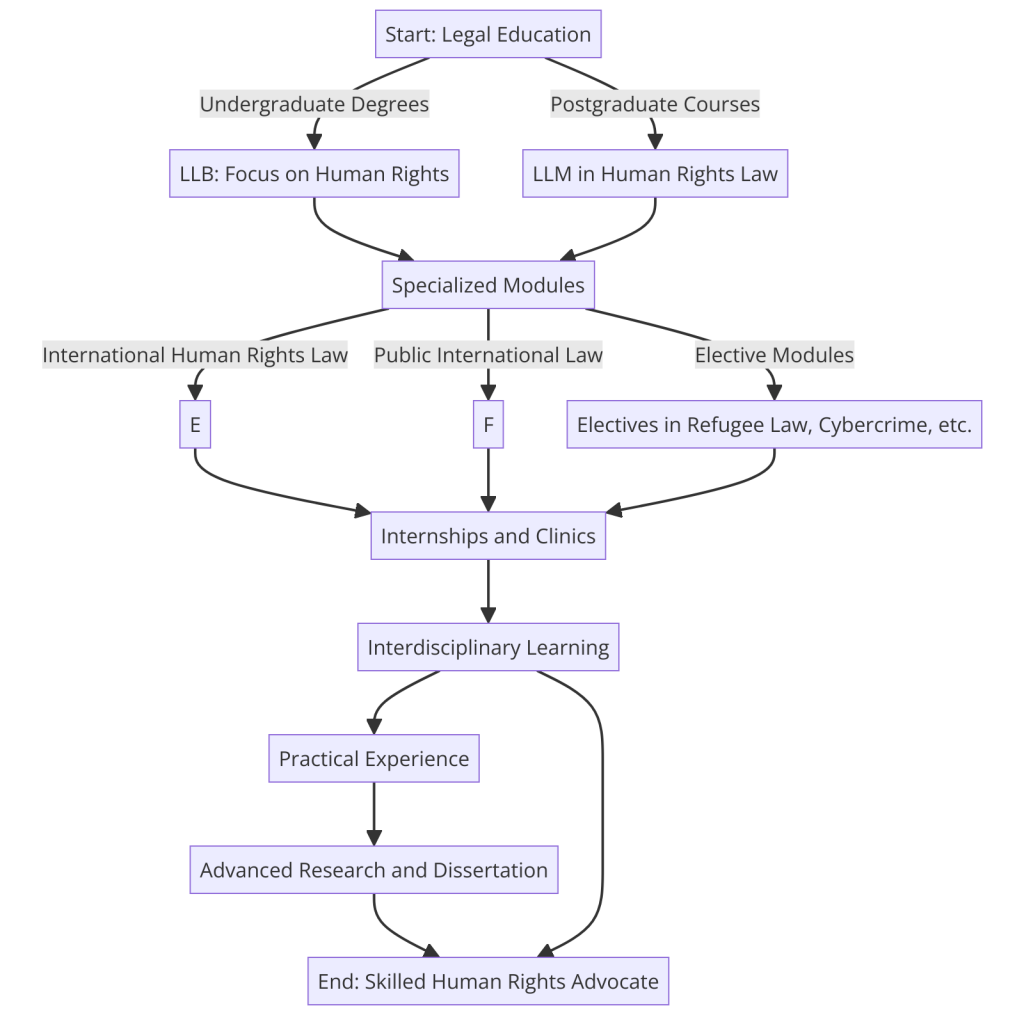
In the quest to cultivate effective human rights advocates, the academic journey is structured and diverse, designed to build deep knowledge and practical skills. Our diagram visualizes this educational trajectory, starting from foundational legal education through to specialized human rights law training. Students begin their path with general legal studies, progressing to specialized modules that cover critical areas such as international human rights, public international law, and specific electives like refugee law and cybercrime law. This progression is enriched by practical experiences through clinics and internships, where theoretical knowledge is applied in real-world settings.
The curriculum is further enhanced by interdisciplinary learning, allowing students to integrate knowledge from various fields such as sociology, political science, and philosophy, providing a broader perspective necessary for addressing complex human rights issues. Ultimately, the pathway leads students towards advanced research and dissertation work, culminating in a comprehensive skill set that prepares them to be advocates capable of navigating and influencing the dynamic landscape of global human rights.
This structured educational outline ensures that students are not only well-versed in the theory of human rights law but are also prepared to engage effectively in its practice, advocating for justice and human dignity worldwide.
Role of Law Schools and Universities in Advocacy Training
Institutions as Pivotal Training Grounds
Law schools and universities play a critical role in shaping the next generation of human rights advocates. These institutions not only provide the academic grounding necessary for understanding complex legal theories but also foster an environment where students can engage with pressing human rights issues. Through their curriculum and extracurricular activities, these institutions imbue students with both the knowledge and the passion needed to advocate for human rights effectively.
Programs and Initiatives in Human Rights Education
Leading law schools often have specific programs and initiatives that focus on human rights. For example, many schools offer clinical programs that allow students to work directly on human rights cases under the supervision of experienced professors and practitioners. These programs may include partnerships with NGOs, government agencies, or international organizations, offering students firsthand experience in the field. Additionally, schools may host annual conferences, guest lectures, and workshops with human rights activists and lawyers, providing students with networking opportunities and insights into real-world challenges and strategies.
Interdisciplinary Learning and Advocacy
Interdisciplinary learning is increasingly recognized as important in human rights education. Many human rights issues intersect with disciplines such as economics, psychology, and sociology. Understanding these intersections can enhance a lawyer’s ability to devise effective strategies for advocacy. Some law schools offer joint degree programs or allow students to take courses in other departments, facilitating a broader and more inclusive approach to human rights issues.
Practical Training and Skills Development
Significance of Hands-On Experience
Practical training is essential in the education of human rights lawyers. Internships, clinics, and externships with human rights organizations provide students with the opportunity to apply legal theories in real-world contexts, engage directly with clients, and learn from experienced practitioners. These experiences are crucial for developing the practical skills necessary for effective advocacy.
Developing Essential Advocacy Skills
Human rights advocacy requires a distinct set of skills including legal research, writing, negotiation, and public speaking. Law schools integrate these skills into their curriculums through moot court competitions, mock trials, and public advocacy projects. These activities not only hone students’ practical skills but also build confidence and competence in public presentations and legal argumentation.
Integration into Curriculums and Professional Development
Law schools increasingly incorporate these practical experiences into their academic offerings, providing structured skill development programs that align with professional standards and requirements. Additionally, continuing legal education programs offer workshops and seminars on current human rights issues and advocacy strategies, ensuring that practitioners remain effective and informed throughout their careers.
Challenges and Opportunities in Human Rights Law
Navigating Contemporary Challenges
Human rights lawyers often face a myriad of challenges that can vary from political pressures and economic constraints to social and cultural barriers. Politically, advocates may encounter resistance from governments or powerful non-state actors reluctant to implement or enforce human rights laws. Economically, limited funding can restrict the scope of work for non-profits and reduce access to justice for marginalized populations. Socially, cultural norms and prejudices can complicate efforts to advance human rights in various regions. These barriers require human rights lawyers to be not only skilled in law but also adept at navigating complex socio-political landscapes.
Opportunities for Impact
Despite these challenges, there are substantial opportunities for human rights lawyers to make a difference. Working with non-profits, international organizations like the United Nations, or even within private law practices that focus on social justice, lawyers can push for change and influence policies. These roles enable them to tackle issues such as human trafficking, environmental justice, and the rights of indigenous peoples, making real differences in communities and on a global scale.
Education’s Role in Overcoming Challenges
Education plays a crucial role in preparing human rights advocates to face these challenges effectively. Through comprehensive training that includes international law, negotiation, and conflict resolution, educational programs equip lawyers with the necessary tools to advocate for human rights despite the obstacles. Additionally, understanding the intersection of human rights with other disciplines, such as technology and business, allows advocates to approach problems with innovative solutions and a broader perspective.
Future Trends and Directions in Human Rights Education
Emerging Trends in Education
Human rights education is continuously evolving, with new trends emerging as the global landscape changes. A significant focus now is on the impact of technology on privacy and freedom, prompting law schools to integrate courses on digital rights and cybersecurity. These courses address issues like surveillance, data protection, and the freedom of information, which are increasingly pertinent in our digital age.
Future Developments in Global Human Rights
Looking ahead, global human rights policies are likely to respond to ongoing crises such as climate change, global migrations, and pandemics, all of which will influence educational practices. As these global challenges emerge, human rights education will need to adapt, preparing advocates to address these complex issues through a human rights lens.
Continuous Learning and Adaptation
The career of a human rights advocate is marked by continuous learning and adaptation. The field’s dynamic nature requires that legal education not only keep pace with current developments but also anticipate future trends. Ongoing professional development and lifelong learning are essential for human rights lawyers to remain effective and informed throughout their careers.
Conclusion: Empowering the Next Generation of Human Rights Advocates
As we have explored, the pathways through which human rights advocates are educated are critical in shaping their ability to navigate and address the myriad challenges they face in their careers. The evolution of human rights education, from academic courses to practical training, prepares these advocates to tackle pressing global issues effectively. With continued focus on interdisciplinary learning and adapting to new global realities, education remains a cornerstone in empowering a new generation of human rights advocates, ensuring they are well-prepared to advance justice and equality in increasingly complex global landscapes.