In an era where digital transformation touches every aspect of our lives, the legal profession stands on the cusp of a significant shift—embracing online education. Gone are the days when the journey to becoming a lawyer was confined to the halls of ivy-covered institutions. Today, online platforms offer a myriad of opportunities for legal education, from obtaining degrees to fulfilling continuing education requirements. This evolution invites both aspiring lawyers and seasoned practitioners to navigate a new learning curve, adapting to virtual classrooms and digital libraries. As we delve into this transition, we explore how online education is not only reshaping the path to legal expertise but also expanding the horizons of what it means to practice law in the 21st century.
The Shift to Online Legal Education
Traditionally, legal education has been a bastion of in-person learning, characterized by Socratic method teaching in lecture halls, rigorous study groups, and the physical presence in moot court competitions. However, a combination of factors has propelled a shift towards online learning environments. Technological advancements have made virtual classrooms and resources more accessible and interactive, offering a realistic alternative to traditional settings. The COVID-19 pandemic accelerated this trend, necessitating a rapid adoption of online learning to ensure continuity in education. This shift has not only been a response to immediate needs but has also highlighted the long-term potential of online legal education.
Universities and specialized platforms now offer a range of options, from online Juris Doctor (JD) programs to short courses targeting specific legal skills or knowledge areas. Institutions like Harvard Law School, Stanford Law, and platforms such as Coursera and edX have expanded their offerings, providing access to legal education across the globe. This digital transformation democratizes legal education, breaking down geographical and financial barriers that once limited access to the legal profession.
Benefits of Online Education for Legal Professionals
The move to online education brings with it several benefits that cater to the modern legal professional. Foremost among these is flexibility. Online courses allow students and practicing lawyers to balance their studies with professional commitments, enabling learning at their own pace and on their own schedule. This flexibility is particularly valuable in the demanding field of law, where balancing continuing education with client obligations can be challenging.
Online learning also offers the ability to tailor educational experiences to individual needs and interests. With a broad spectrum of courses available, learners can focus on niche areas of law that may not be as readily available in traditional settings. This customization enhances the relevance and application of education to one’s career path.
Cost-effectiveness is another significant advantage. Online programs often come with lower tuition fees and eliminate the need for commuting or relocating, making legal education more accessible to a wider audience. Moreover, the online format can foster a more diverse and inclusive learning environment. It opens doors for individuals who might have been excluded from traditional legal education due to financial constraints, disabilities, or other barriers, enriching the legal community with a wider range of perspectives and experiences.
Challenges and Considerations
While the shift toward online legal education heralds numerous benefits, it is not without its challenges and considerations. A primary concern among critics is the quality of online legal education compared to traditional, in-person instruction. Skeptics question whether virtual classrooms can offer the same level of rigorous debate, engagement, and immediate feedback that face-to-face interactions with professors and peers provide. The Socratic method, a staple of legal education that thrives on spontaneous dialogue, is particularly challenging to replicate in an online environment.
Another significant debate centers around the effectiveness of online education in imparting practical legal skills. While theoretical knowledge can be conveyed through digital means, the nuances of applying law in real-life scenarios—such as courtroom etiquette, negotiation tactics, and client interactions—are harder to simulate online. Despite advancements in technology, such as virtual reality moot courts and interactive simulations, there remains a gap in hands-on experience that is vital for budding lawyers.
Networking and relationship-building present additional hurdles in an online setting. The legal profession thrives on connections made through law school cohorts, internships, and extracurricular activities. While online platforms offer forums, group projects, and virtual events, these may not fully replicate the depth of relationships formed in person, potentially impacting students’ career opportunities and mentorship experiences.
Accreditation and recognition of online law degrees and courses also pose a significant challenge. Regulatory bodies and the legal profession at large have been slow to adapt to online education, leading to varying levels of acceptance for online credentials. This uncertainty can affect graduates’ eligibility to sit for the bar exam, their job prospects, and their overall career trajectory within the legal field.
The Impact of Online Education on Legal Practice
The advent of online legal education is not only transforming how lawyers are trained but also influencing the practice of law itself. New lawyers entering the profession now come equipped with a different set of skills and knowledge shaped by digital learning. They are often more adept at utilizing legal technology tools, conducting online research, and leveraging digital platforms for case management and client communication. This digital savviness can lead to more efficient practice, innovation, and a greater willingness to embrace new technologies in legal work.
Online education plays a pivotal role in continuing legal education (CLE) for practicing lawyers. The convenience and accessibility of online CLE courses enable lawyers to stay updated on the latest laws, regulations, and practice trends without the time and expense associated with traditional in-person seminars. This ease of access encourages a culture of lifelong learning within the profession, ensuring that legal practitioners can continually refine their expertise and adapt to the evolving legal landscape.
The widespread adoption of online education is likely to usher in broader changes in the legal profession. It may lead to a more diverse legal workforce, as individuals who previously faced barriers to accessing legal education—due to geography, finances, or personal commitments—can now pursue their legal aspirations. Furthermore, as online education emphasizes self-directed learning and digital collaboration, it could foster a generation of lawyers more inclined towards innovation, challenging traditional hierarchies and processes within law firms and the broader legal ecosystem.
As we navigate these transformations, it is clear that online legal education holds the potential to reshape the contours of legal practice, making it more inclusive, efficient, and adaptive to the demands of the 21st century. However, realizing this potential requires addressing the aforementioned challenges, ensuring that online legal education not only matches but enhances the quality and applicability of traditional legal training.
Embracing the Future: The Evolution of Online Legal Education in 2023
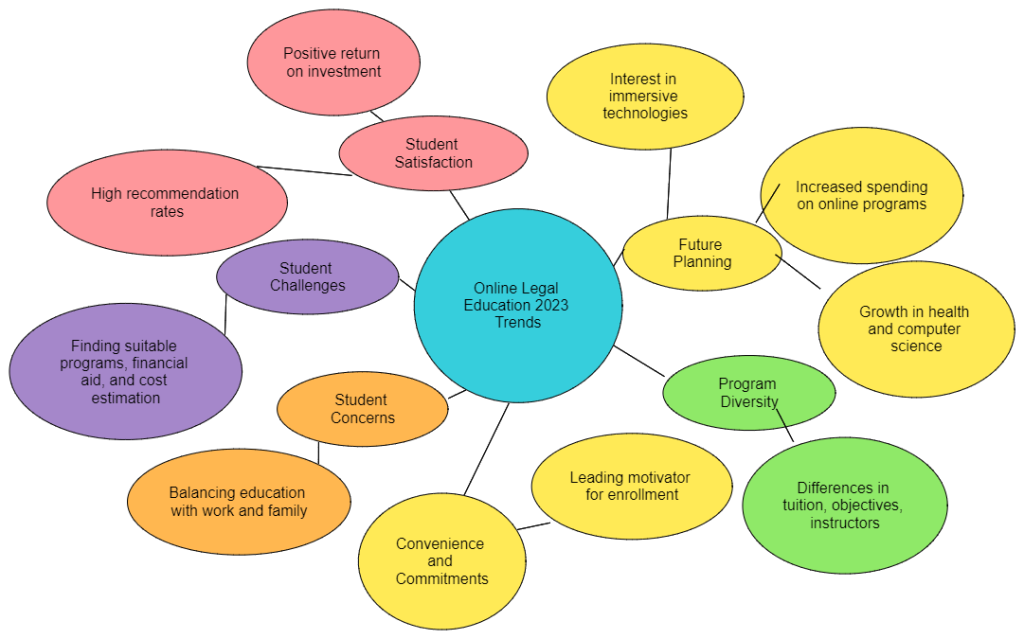
In the rapidly evolving landscape of legal education, 2023 marks a pivotal year of significant transformations and trends that promise to redefine the traditional pathways to legal expertise. As online legal education gains unprecedented momentum, it stands at the forefront of democratizing access to legal knowledge and skills, propelled by the collective aspirations of aspiring lawyers and seasoned practitioners alike. This section delves into the intricacies of these emerging trends, offering insights into the motivations driving enrollment, the diversity of program offerings, student concerns and challenges, and the overarching satisfaction and future outlook of online legal education.
Convenience and Flexibility: A primary motivator for students enrolling in online legal programs is the unparalleled convenience and flexibility these platforms offer, allowing learners to seamlessly integrate their education with personal and professional commitments.
Diverse Program Offerings: The landscape of online legal education in 2023 is characterized by a rich diversity of programs. These programs distinguish themselves through varied tuition fees, learning objectives, and instructor expertise, catering to a wide spectrum of educational needs and preferences.
Addressing Student Concerns: Amidst the convenience, the transition to online learning also brings forth concerns among students, chiefly regarding the balance between education, work, and familial obligations. Addressing these concerns is crucial for the sustained growth and acceptance of online legal education.
Navigating Challenges: Students face several challenges, from selecting the right program that aligns with their aspirations to navigating the complexities of financial aid and managing the costs of education. Overcoming these challenges is essential for prospective students to fully leverage the benefits of online learning.
Student Satisfaction and ROI: Reflecting on the value of their investment, an overwhelming majority of students express satisfaction with their online legal education, acknowledging its positive impact on their career trajectories and the substantial return on investment it offers.
Future Perspectives: Looking ahead, the commitment to online legal education is evident in the increased spending and development of programs, especially in burgeoning fields like health professions and computer science. Furthermore, the exploration of immersive technologies like virtual reality presents exciting possibilities for enhancing the online learning experience.
As we navigate through these transformative times, online legal education emerges not just as an alternative, but as a compelling and comprehensive pathway to legal proficiency. It encapsulates the essence of modern education—innovative, inclusive, and infinitely adaptable to the evolving demands of the legal profession.
Emerging Trends and the Future of Legal Education
As we venture into the future of legal education, it’s clear that innovation and technology will play pivotal roles. The integration of virtual reality (VR) simulations into online learning platforms is poised to revolutionize the way law students practice courtroom presentations, participate in mock trials, and engage with complex legal scenarios in a highly immersive environment. Similarly, Artificial Intelligence (AI) is transforming legal research, making it faster and more efficient, thereby enhancing students’ ability to understand and apply legal precedents and regulations.
The focus on specialized areas of law is another trend gaining momentum. As the legal landscape becomes increasingly complex, there’s a growing demand for expertise in niche areas such as cybersecurity law, intellectual property law, and environmental law. Online education is uniquely positioned to cater to these needs, offering specialized courses that might not be feasible in traditional law school settings due to limited student numbers or resources.
Looking ahead, we can expect online legal education to continue evolving, driven by technological advancements and changing societal needs. This evolution will likely blur the lines between traditional and online education, leading to hybrid models that combine the best of both worlds. The impact on the legal profession will be profound, with a new generation of lawyers entering the field with a diverse set of skills, honed not just through textbooks and lectures, but through interactive, technology-enhanced learning experiences.
In conclusion, the journey through the transformation of legal education highlights the immense potential of online learning in shaping the future of the legal profession. As we stand on the brink of this new era, it’s an invitation to current and aspiring legal professionals to embrace online education as a vital tool for career development and lifelong learning. The advancements in technology not only make learning more accessible and engaging but also ensure that legal education remains relevant in the fast-paced, ever-changing global landscape.
For the legal profession and society at large, the shift towards online legal education is not just about adapting to technological changes; it’s about seizing the opportunity to make legal education more inclusive, diverse, and aligned with the needs of the 21st century. As we look forward, let’s champion the innovations that make this possible, ensuring that the legal field continues to grow and evolve in ways that serve justice, equity, and the common good.